

Every year, millions of Americans receive reassuring results from their annual physicals and routine heart screenings. Normal cholesterol levels, healthy blood pressure, and an unremarkable ECG often provide peace of mind. However, these standard tests may not always reveal the complete picture of your cardiovascular health.
Heart disease remains the leading cause of death in the United States, yet many individuals who experience a heart attack had no prior warning signs. This growing gap between routine screening and early detection is driving greater interest in preventive cardiology, personalized monitoring, and advanced cardiovascular risk assessment.
Why Standard Heart Screenings Have Limitations
Traditional heart screenings including cholesterol panels, blood pressure measurements, resting ECGs, and routine physical examinations play an important role in preventive healthcare. However, these tests primarily estimate heart disease risk across large populations rather than identifying the earliest biological signs of disease in an individual.
A comprehensive cardiac risk assessment should evaluate more than just standard laboratory values. Many cardiovascular changes begin long before symptoms develop or routine tests become abnormal.
The 75% Problem
Research from UCLA Health found that nearly 75% of patients who suffered a heart attack had cholesterol levels that did not indicate elevated cardiac risk beforehand.
This highlights an important limitation of relying solely on traditional screening methods. Instead of detecting early disease, conventional screening often estimates the statistical likelihood of future events. Unfortunately, this means subtle cardiovascular changes may go unnoticed for years.
Why Early Heart Disease Is Often Silent
One of the biggest challenges in cardiovascular prevention is that heart attacks are silent until they become medical emergencies.
Before symptoms appear, several biological processes may already be occurring:
- Chronic low-grade vascular inflammation
- Endothelial dysfunction
- Early plaque formation
- Progressive arterial changes
These early stages of coronary heart disease (CAD) rarely produce noticeable symptoms. Individuals often feel healthy while the disease continues to progress beneath the surface.
By the time chest pain or shortness of breath develops, cardiovascular disease may already be significantly advanced.
Understanding Coronary Heart Disease (CAD)
Coronary heart disease (CAD) occurs when plaque gradually builds up inside the coronary arteries, reducing blood flow to the heart muscle. CAD remains one of the most common forms of cardiovascular disease and a major contributor to heart attacks worldwide.
Because plaque develops slowly over many years, many people living with CAD have no symptoms until a serious cardiac event occurs.
This is why physicians increasingly emphasize earlier detection and individualized cardiovascular risk assessment rather than waiting for symptoms to appear.
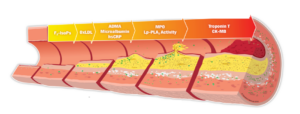
What Advanced Cardiac Risk Assessment Looks Like
Modern preventive cardiology is shifting from simply estimating future risk toward identifying cardiovascular disease at its earliest stages.
A more comprehensive cardiac risk assessment may include:
- Advanced cardiovascular biomarkers
- Vascular inflammation markers
- Endothelial function testing
- Longitudinal biomarker tracking
- Individualized physician evaluation
Rather than relying on a single annual snapshot, these approaches evaluate changes over time, providing physicians with a more complete understanding of cardiovascular health.
Why Cardiovascular Prevention Matters
According to the Centers for Disease Control and Prevention (CDC), cardiovascular disease remains the leading cause of death in the United States. Approximately 805,000 Americans experience a heart attack each year, and someone dies from cardiovascular disease every 33 seconds.
#1 cause of death in the United States
805,000 Americans experience a heart attack each year
33 seconds between cardiovascular deaths
These numbers reinforce why cardiovascular prevention should begin long before symptoms develop.
Early identification of cardiovascular changes allows physicians and patients to make informed decisions regarding lifestyle, monitoring, and medical management before significant disease develops.
A Personalized Approach to Heart Health
Healthcare is increasingly moving toward personalized medicine, and cardiovascular care is no exception.
While annual physicals remain valuable, they represent only one piece of the puzzle. Individualized cardiovascular risk assessment focuses on understanding a person’s unique biology rather than relying solely on population averages.
This evolving approach enables physicians to identify subtle cardiovascular changes earlier and monitor progression over time, helping patients make proactive decisions about their heart health.
The Future of Preventive Cardiology
The future of preventive cardiology lies in combining traditional screening with individualized cardiovascular evaluation.
Rather than waiting for symptoms or worse, heart attack early detection strategies seek to identify disease before it becomes clinically apparent.
As research continues to advance, comprehensive cardiac risk assessment and personalized monitoring may play an increasingly important role in reducing the burden of coronary heart disease (CAD) and improving long-term cardiovascular outcomes.
Key takeaways
- Standard screening estimates population risk; it does not detect early disease in an individual.
- Nearly 75% of heart attack patients had cholesterol levels that gave no warning.
- Inflammation, endothelial dysfunction and early plaque all precede symptoms — often by years.
- Tracking biomarkers over time reveals change that a single annual snapshot cannot.
Sources & Further Reading
- Centers for Disease Control and Prevention — Heart Disease Facts. cdc.gov/heart-disease
- American Heart Association — Understand Your Risk for Heart Disease. heart.org
- American Heart Association — Healthy Living and Prevention. heart.org/healthy-living
- UCLA Health. uclahealth.org
- National Heart, Lung, and Blood Institute — Coronary Heart Disease. nhlbi.nih.gov
Medical disclaimer. This article is provided for general educational purposes only and does not constitute medical advice, diagnosis, or treatment. It is not a substitute for consultation with a qualified healthcare professional. Always seek the advice of your physician or another qualified provider with any questions regarding a medical condition. If you think you may be having a medical emergency, call 911 immediately.